
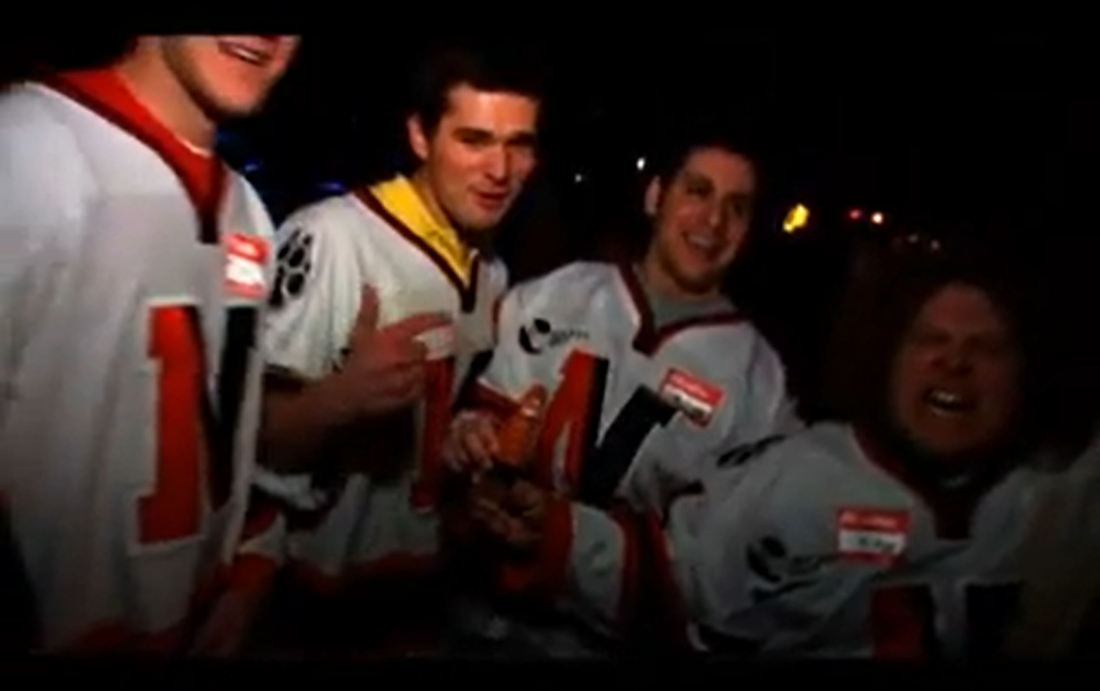
Learn about the unknown history and insane stories of the most important intercollegiate showdown you’ve never heard of – The 2007 QDOBA Rice and Beanpot.
Written by Michael Ruberto.
The Super Bowl. The World Cup. March Madness. In our society, major sporting events have a way of transcending athletics to become cultural touchstones that live in the hearts and minds of people everywhere. Though many of these events may be world renowned spectacles worth billions of dollars, they pale in comparison to one contest. A brief but brilliant tournament pitting local college students against one another, fueled by an intense rivalry, and an even more intense desire for free food: The QDOBA Rice and Beanpot.
The Rice and Beanpot first came from humble beginnings in the mid 2000s when Jeff Ackerman, a Boston College alumnus and restaurant owner, opened 20 new QDOBA restaurants in the Greater Boston Area. At the time, the popular Mexican chain was relatively new to the region. In order to come up with a way to draw in more customers, Ackerman turned to Scott Bernstein, the founder of the marketing agency Blitz Media.
“Jeff was my client,” Bernstein explained. “Our job was to help open up all the QDOBAs, and part of that effort was sponsorship. And so because he was on the BU, BC, Northeastern, and Harvard campuses all by chance, we came up with this idea to do a Rice and Beanpot.”
The competition, a play on the name of the famous hockey tournament between those same four schools, would be a competitive eating tournament which would see teams of four students compete to eat one burrito each relay style as quickly as possible. A qualifier would be hosted at the restaurants closest to each college, and the winning teams would go on to represent their schools in the finals at the Paradise Rock Club.
“We really made a lot of our early real estate centered around college campuses,” Ackerman recounted. “This whole concept was a great way to not only get people to try the food, but to literally shove the food in their mouths, you know? What’s a better way to get to the hearts and minds of college kids?”
And it did exactly that.
Chris Barone, who graduated from Northeastern in 2009, represented the Huskies in the 2007 Rice and Beanpot. For him and his friends, the decision to participate was an easy one.
“There would’ve been advertisements about it around campus or something like that, and so we saw them,” Barone said. “Me and my buddies were all just fat pigs, so we were just like, ‘Oh man, let’s go to QDOBA!’ I mean, you’re getting a free burrito as a college kid.”
Barone served as the captain of his four-man squad, which they had named Team Fisherman after a friend of theirs. This mantle was a responsibility that he had to earn.
“[I was captain because] I was the fastest eater on the team,” he explained. “And obviously the most charismatic and good looking.”
According to Ackerman, there would be, on average, six to eight teams at each school’s qualifying event. Team Fisherman admittedly didn’t do much in the way of preparation before the Northeastern round, but in the end they were still able to power through and earn the right to represent the Huskies in the finals. Now, it was time to develop a serious practice regimen.
“We didn’t do any training before we won Northeastern,” said Ryan Graf, Northeastern class of 2009 and leadoff eater for Team Fisherman. “But then the QDOBA owner loved us and gave us free burritos whenever we came in, so we pretty much just hit that up a couple times a week to practice before the main [competition] because, once again, free food.”
The main event was a much larger spectacle than the local qualifiers, only made possible through long nights of planning between Ackerman and Bernstein.
“It was a fair amount [of work], not to over-dramatize it,” Ackerman described. “Scott and I almost worked on it as a labor of love pet project. Scott and I became good friends and we’d literally just sort of work on it in our free time at night, sort of brainstorm and knock things out. Scott’s team certainly did a lot as well, but I don’t think it would’ve happened without the two of us at night putting all the pieces together.”
For the duo, the Rice and Beanpot finals were about more than just the rice and beans. They wanted to pack the club and make it a huge entertainment event.
“We really created a Beanpot Battle of the Bands too. We tried to get a band from each school to play. That sort of played out in some years, in others it didn’t. We got state radio there one year. We got some big emerging artists,” Bernstein explained.
Ultimately, they achieved their goal, creating a memorable, high-energy show for all the spectators in attendance.
“The venue wasn’t super huge, but they probably got like 500 people in there, so it was pretty decent,” Graf recalled.
“I remember there was this one girl just screaming at the top of her lungs like this fucking matters,” Barone laughed. “It might as well have been the World Cup. It was a pretty good vibe.”
Besides the raucous atmosphere, another aspect of the Rice and Beanpot that made the event special was that it benefitted a greater cause than just feeding hungry college students – the tournament helped to raise money for the Cam Neely Foundation, an organization created by the Boston Bruins legend to help support cancer patients and their families throughout the treatment and recovery process.
“We went to Cam Neely and his brother Scott who ran the Cam Neely Foundation and we got them involved which was great because we got a presence out of Cam himself for an appearance, and they really embraced the event,” Bernstein remembered.
“We auctioned off a bunch of Cam Neely paraphernalia – hockey sticks, jerseys, that kind of stuff – that’s how we got a lot of the money. And they loved the exposure too because we put their logo on all of the stuff we did,” Ackerman chimed in. “We wrote a nice big check at the end to the charity, actually. … I wanna say it was like fifteen to twenty grand?”
As the 2007 finals got underway, Northeastern’s hopes of beating their longtime rivals rested in the hands – and stomachs – of Team Fisherman. This was a job that Ryan Graf and the rest of the group took seriously.
“[Representing Northeastern] was super fun, especially with the Beanpot and all the rivalries. At least me and a couple of the guys were big hockey fans too. I think we lost in the Beanpot that year so it was good to try and get revenge in a way that did not matter nearly as much.”
For the captain, who was among the fastest in the tournament, something of a personal rivalry was beginning to form as well.
“There was some kid from BU, and if I remember correctly the kid was like a snake,” Barone laughed. “He just like, I think he unhinged his jaw and just kept slowly pushing the burrito into his mouth. It was bizarre. He was sort of like my arch nemesis because he and I were faster than everybody else in the whole competition.”
The final relay was grueling, but Team Fisherman was determined to bring home the victory for the Huskies. The first three eaters got off to a strong start.
“I think our average team time was around two and change? I was pretty consistent at like 30 seconds because I was always the one who went first. Our two middle guys were a bit slower, around 40 seconds or so? Maybe 45 seconds?” Graf described.
The team’s championship dreams came down to Chris Barone, who, in a feat of herculean strength, managed to finish his 18oz burrito in just 19 seconds. Northeastern University had won the 2007 QDOBA Rice and Beanpot.
Team Fisherman certainly made the most out of their moment of triumph, becoming very niche, very local celebrities for a very short amount of time.
“I think at one point they had our pictures up at the QDOBA of the team and all that,” Barone recounted. “We even went on TV one time, not that it would matter, but it was like a morning Fox News thing they had us on. … A couple days after I was on the T and some lady was like ‘You’re the kid from the TV!’ So I guess some people were watching it.”
And of course, no tournament would be complete without a grand prize.
“When we won that year they gave us like, I wanna say it was an all-expenses-paid trip to Cancun for the four of us. We got free tickets and accommodations, it was kinda cool,” Barone said. “There was also this guy from, like, the Nantucket Nectars company. I met this guy before the show and he was all drunk and he was like, ‘If you guys win I wanna buy you guys jackets!’ I just said, ‘You’re gonna have to buy us nice fucking jackets because I’m gonna win.’ … They came through, gave us all these cool jackets.”
What started as a gimmick to lure hungry college kids into a new Mexican chain restaurant had quickly evolved into something truly special – a competitive eating spectacle for students to race against one another in front of an energetic crowd to help write another chapter in an already great rivalry between four Boston-area schools, while also raising thousands of dollars for a noble cause just for good measure. And yet, to quote the immortal words of poet Robert Frost, “Nothing gold can stay.”
The Rice and Beanpot would ultimately be short lived. After a few years, Jeff Ackerman sold his QDOBA franchises back to corporate, who elected not to continue the event.
“It was a lot to take on, because again, you’re running five events, multiple locations, all the stores had to be aligned, it was a big endeavor. In fact, when I sold the businesses back to the brand, they chose not to take it on because it really was a real endeavor,” he recounted solemnly. “Corporate I don’t think had that – you know, I went to Boston College, [Scott and I] are both from Boston, and I’m a big college hockey fan. Some of our event fed off of that love of the Beanpot. Corporate, who was Denver based at the time, they loved what we did … but they just didn’t have that same passion.”
Even though the QDOBA Rice and Beanpot is no longer with us, the memories and the friendships it created deserve to be remembered among the other pillars of Boston, and Northeastern, history.
“I just have this memory of the two of us standing on the stage, Jeff and I, at the Paradise,” Bernstein remembered. “We were kicking it off, I think it was year three, and we were just looking at each other thinking, ‘Look at what we created,’ just really enjoying the fruits of our labor. That memory always sticks in my head.”
 The Red & Black